
- Home
- Deceptions
- Solar
- Thermal Audit
- Ventilation
- Sensors
- Governance
- Environment
- Reference
- Contact
- News

Vertical Axis Wind Generators
Anytime you see a wind generator that has a vertical axis, you should be thinking scam. There are a few legitimate companies that create vertical axis generators just because they want to, and coupled with a high efficiency alternator might have acceptable economics - however many are scams and the vertical format is perferred because they look cool. Vertical axis machines are usually mounted at ground level where, unfortunately, wind speeds are the lowest. Since the wind power available is proportional to the cube (3rd power) of the wind speed, if you have half the wind speed at ground level that you have on a high tower, then you also have 1/8 (e.g. 1/2 * 1/2 * 1/2 = 1/8) the power. In other words, if you raise a turbine on top of a tower where the wind is twice as fast, you get 8 times more power. This a significant difference that has a huge influence on the economics.
One common way of estimating wind speeds close to the ground is the power law. Standard wind speeds from your weather bureau are based on an anometer height of 10m (30 feet). If the hub of the turbine is at 20m instead, then the wind speed will be approximately (20m/10m)^0.14 = 1.1 times greater. In words, the height of the tower divided by the reference height all to the power of one seventh gives you factor which, when multiplied by the reading from you weather station, gives you the expected wind speed at your wind turbine.
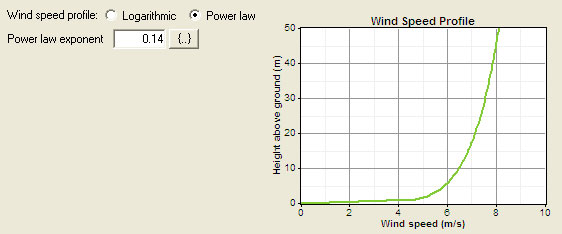
Notice that as the height in the graph above drops below 5 m (15 feet), wind speed rapidly approaches zero. This means that you don't get much wind speed near the ground, and coupled with the fact that the power you can extract is proportional to the cube of the wind speed (e.g. speed times speed times speed) -- you can see why having any wind generator close to the ground will be disappointing. Of course you could make the vertical turbine several times larger to compensate for the low wind conditions, but that will also rapidly increase the cost and engineering complexity. The vertical mill has a further disadvantage in that half of the unit is rotating into the wind at all times. This makes for a physically larger turbine and reduces its efficiency compared to a horizontal axis unit.
Some vertical axis turbines claim to use magnetic levitation to improve efficiency. This doesn't make sense since frictional losses are minor and a magnetic bearing would need either a huge set of permanent magnets, or a source of power for an electromagnet as well as special techniques to keep it stable.
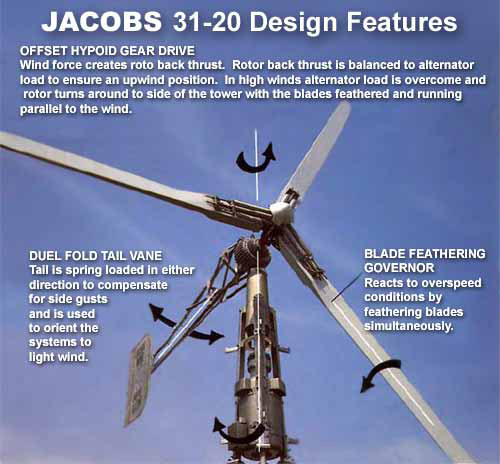
A good design for a small turbine would be similar to the Jacobs shown below. The blades rotate to face the wind and the propeller blades have an airfoil shape, which generates lift. The entire assembly faces into the wind.
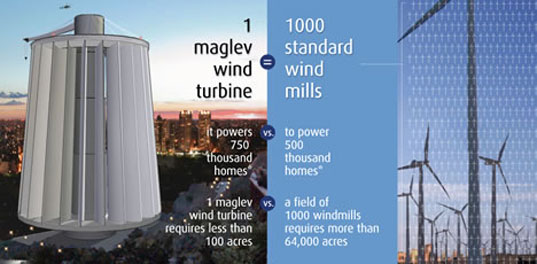
The image below is one called "THE MAGLEV: The Super-powered Magnetic Wind Turbine". Magnetic levitation (or Maglev) means that they have a pair of magnets at the base that act as a low friction bearing. In any case, even if they could get the MagLev working and it functioned better than a thrust bearing, the gargantuan proportions of this vertical turbine are sheer lunacy -- designed to attract naive investors perhaps. They claim that the "Zhongke Hengyuan Energy Technology has invested 400 million yuan ($5.8 million) in building this facility" which if true, is pathetic.
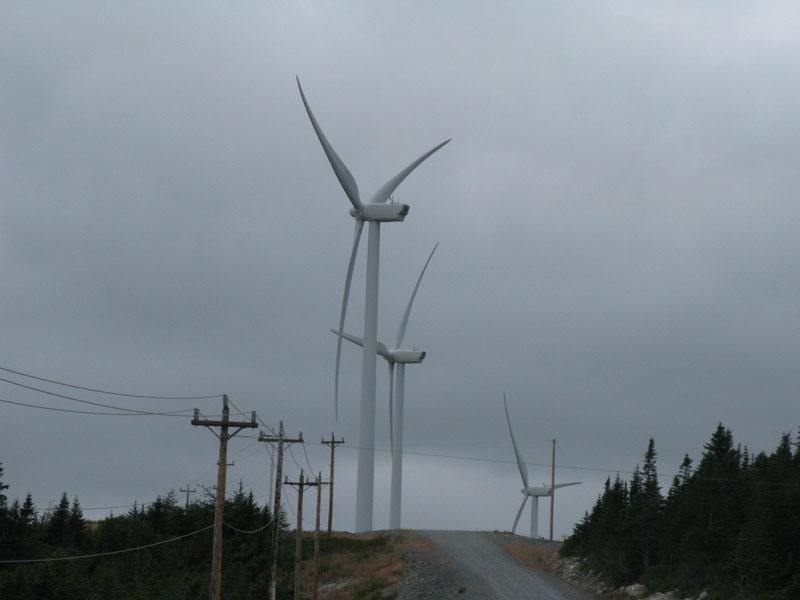
By way of comparison, here is a picture of a real, commercial wind farm on the north Atlantic coast of North America. Compare the last wooden utility pole with the tower for a sense of scale. Imagine the blade area of a thousand of these things, and double it since only half the "maglev" turbine is moving with the wind (the other half is rotating against the wind, a problem horizontal axis machines do not have since they always face the wind). A vertical turbine that covers 100 acres is a fantasy, and would likely be wrecked by a good storm.
 .
.
The next clip is a small video with sound that shows a generator in relation to a minivan. There is some wind noise as wind blows over the camera's microphone that you can hear quite loudly at 33 seconds and a few other spots. All the other noise can be heard with your ears. The high frequency sounds didn't record -- it is an erie noise that sounds like aliens in a science fiction movie and something you have never heard before.
Rooftop Wind Turbines
Anyone that suggests that you can mount a wind turbine large enough to significantly reduced you power bills on your roof is either naive or scamming you. Any generator that is large enough to generate useful amounts of power will buckle the roof during windy periods. Roofs in North America are usually made from 2x4 wooden studs and thin plywood - this are totally unsuitable for mounting a wind turbine. Aside from mounting problems, wind is extremely turbulent and considerably slower close to ground. In order to get decent performance out of a generator, you need to mount it about 30 feet above buildings and trees.
The Betz Limit
As a thought experiment, imagine what would happen if a turbine could stop all the wind blowing at it. Instead of getting maximal energy extraction, generation would halt because no wind would be passing through the blades and rotation would stop.
Somewhere there is a happy medium, a point where you are slowing down the wind, extracting energy, but still allowing significant volumes to pass through. It has been proven that this point, the maximum theoretical efficiency, is about 59%, and is referred to as the Betz limit.
The Danish Wind Association has a proof of Betz' Law. Wikipedia also has a proof of the Betz limit.
The bottom line is that no wind turbine can extract more than 59% of the wind's energy, and any one that claims fraudulently that they can, is selling you a "Betz Beater".
Outrageous Claims
One of the more ridiculous promoters of wind generators is the Earth4Energy / HomeMadePowerPlant scam, which claim you can build a home generator for less than less than $200. Statements like "why you should always build a wind generator (it only takes few hours and can be built almost for free) instead of buying it. After you read chapter 4 I’m sure you’ll know for sure what you need to do." are ridiculous. There are good books out there, like Homebrew Wind Power that show you how to build small scale wind turbines and alternators, but it is definitely not a trivial task.
Using the equations for calculating power output from the a wind turbine, we get the following:
Wind Turbine Power:
P = 0.5 x rho x A x Cp x V^3 x Ng x Nb
where:
P = power in watts (746 watts = 1 hp) (1,000 watts = 1 kilowatt)
rho = air density (about 1.225 kg/m3 at sea level, less higher up)
A = rotor swept area, exposed to the wind (m2)
Cp = Coefficient of performance (.59 {Betz limit} is the maximum theoretically possible, .35 for a good design)
V = wind speed in meters/sec (20 mph = 9 m/s)
Ng = generator efficiency (50% for car alternator, 80% or possibly more for a permanent magnet generator or grid-connected induction generator)
Nb = gearbox/bearings efficiency (depends, could be as high as 95% if good)
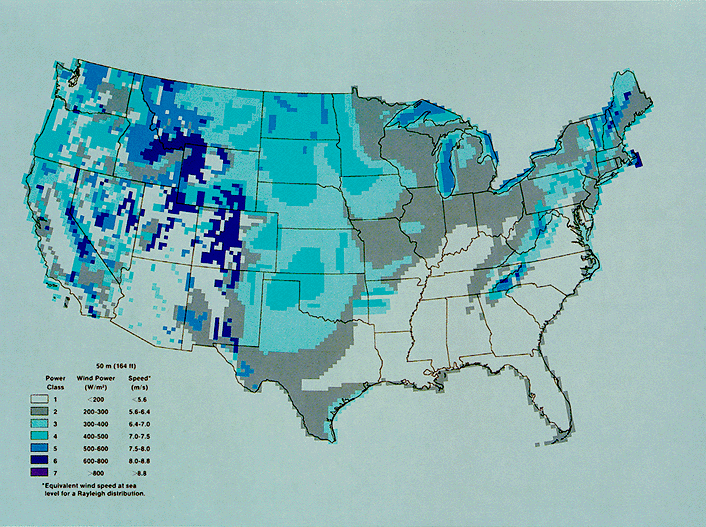
So, lets assume we see an advertisement for a 1200W turbine, and we wonder how big it might be to make this much power at a wind speed of 15 mph or 6.75 m/s, which corresponds to the light blue in the map below.
The equation now becomes:
Area = 1200W/(0.5 x 1.225 kg/m3 x .35 x (6.75m/s)^3 x .80 x .95 )
Area = 23.9 m2
That gives us a diameter of 5m or about 15 feet, which is a large device. Now how big do you think this little thing is (they claim 1200 Watts).
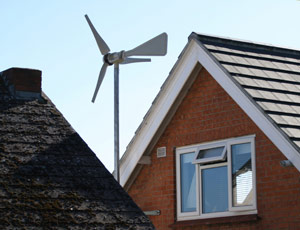
Since it can't be more than a meter in diameter, lets determine how fast the wind would have to be:
(wind speed m/s)^3 = 1200W/(0.5 x 1.225 kg/m3 x .35 x .80 x .95 x 1m2)
Wind speed = 18m/s = 42 miles per hour. You won't be getting these kind of sustained winds in the location pictured above.
If you are serious about wind generation and have the room to erect a tower, perhaps 60 feet tall in the back yard, and have the finances, then there are many good engineering companies that can install commercial equipment for you.
If you are simply interested in knowing how to make your own, want to have a state of the art understanding of the issues, or are are mechanically inclined and want to build your own from scratch, then I recommend you get the Homebrew Wind Power book.